
Magazine
The electric car motor and its role in powering the vehicle
The transition towards sustainable mobility is radically transforming the transport sector worldwide and changing our daily habits. At the heart of this technological and environmental revolution lies a key component that is replacing decades of traditional mechanical engineering. To understand the essence of this innovation, we need to analyse the electric car motor and its direct impact on everyday driving dynamics. The simple engineering of this propulsion system contrasts starkly with the complex architecture of vehicles of the past. The automotive industry’s shift away from reliance on fossil fuels is allowing us to embrace a vision in which clean energy takes centre stage on city streets and motorways. In this new scenario, propulsion is no longer associated with noise or internal combustion, but with an invisible flow of electrons that generates continuous and incredibly smooth motion. Growing consumer interest and international directives on reducing emissions are speeding up a process that is now irreversible in every European country. Within a few years, the vast majority of vehicles sold will be using this quiet, clean technology, changing the face of our cities forever. This transformation involves not only car manufacturers, but an entire industrial ecosystem that is undergoing a reorganisation to support the new era of sustainable mobility.
How an electric car motor works and how it differs from a combustion engine
When you first encounter this innovative world, it is only natural to wonder exactly how an electric motor works and how it manages to move masses of over a thousand kilograms with such ease. The basic principle is founded entirely on the laws of electromagnetism. Inside the motor, there are two main components that work in perfect and constant synergy: the stator and the rotor. The stator is the stationary part of the system, consisting of a complex series of copper wire windings. When current flows through these windings, a very powerful rotating magnetic field is generated. The rotor, on the other hand, is the moving part, situated inside the stator. Under the direct influence of the magnetic field generated by the stator, the rotor begins to rotate on its own axis to follow the magnetic flux, thereby producing the mechanical energy required to move the wheels of the car.
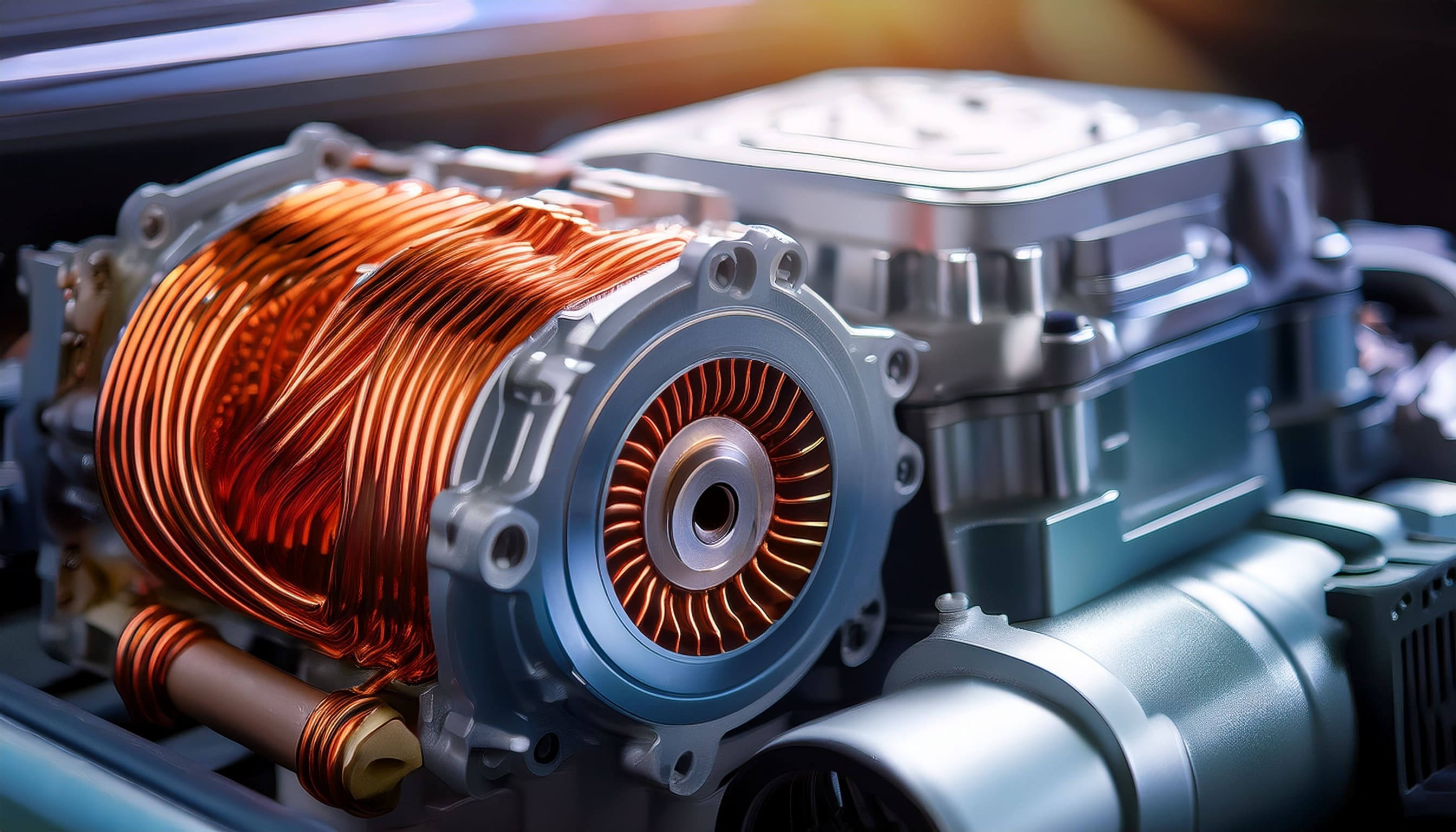
The transformation process
This invisible process converts the electrical energy stored in the battery into the driving force in an extremely direct manner and without any complex intermediate steps. The difference compared with the traditional internal combustion engine is striking and structurally fascinating in many respects. In conventional vehicles, power is generated through a continuous series of controlled explosions inside metal cylinders. A precise mixture of air and fuel is violently compressed by the pistons and then ignited by a spark or simply by the enormous pressure created. This process causes the gases to expand rapidly, pushing the piston downwards and causing the crankshaft to rotate rapidly. This outdated system requires a huge number of constantly moving parts, including valves, camshafts, timing belts, and a complex exhaust system to expel the combustion gases. Each of these components adds weight, friction, potential wear and the need for continuous lubrication, while the zero-emission vehicle is a masterpiece of engineering minimalism and pure rationality. There are no highly flammable liquids to be burned, no exhaust gases to be filtered, and no red-hot exhaust pipes to be replaced over time. Even transmission has been radically simplified, as the vast majority of these vehicles use a single gear capable of covering the entire range of speeds available without any need for clutches or complex, delicate gearboxes. This radically reduces the maintenance required over the years, with significant savings for the owner. These cars need taking to the workshop almost exclusively for visual checks on the brakes, tyres and the specific coolants of the battery pack, making their service life significantly longer.
How electric vehicle motors work in everyday use
To fully and thoroughly understand how an electric vehicle motor works, we need to introduce another essential component, known in the industry as an inverter. Heavy lithium-ion batteries store energy in the form of direct current, but almost all of the electric motors we are talking about here operate using alternating current. The inverter has the delicate, crucial task of instantly converting the direct current drawn from the battery into alternating current, sending it to the stator at exactly the right frequency and voltage to deliver the speed and power required by the driver at any given moment. The moment the driver presses the accelerator pedal, an electronic signal tells the inverter exactly how much power to deliver. The greater the pressure on the pedal, the higher the frequency of the current sent to the motor, resulting in an immediate increase in the speed of the vehicle.
This sophisticated electronic control system makes the throttle response incredibly reactive, without the annoying, perceptible lag typical of older car engines. Because there are no gas mixtures to be drawn in and no mechanical gears to be downshifted, acceleration is instantaneous and perfectly linear throughout the entire range of speeds on the road. This electronic component acts as a veritable ‘thinking brain’, able to manage enormous flows of energy with pinpoint accuracy and in imperceptible fractions of a second. During gradual deceleration, the inverter manages the famous regenerative braking, literally reversing the flow of energy within the system. In this specific case, the rotor temporarily acts as a powerful generator, converting the kinetic energy of the decelerating vehicle into valuable new electrical energy, which is immediately fed back into the main battery. This extraordinary ability to recover valuable energy makes driving in urban areas particularly advantageous for those seeking maximum sustainability in their daily commute, and also helps to significantly increase the vehicle’s overall range without having to use external charging stations.
The impact of the electric car motor on driving dynamics and performance
The historic shift from combustion to electrification brings with it an undeniable engineering advantage that cannot and must not be ignored: the supreme energy efficiency achieved. The most sophisticated, state-of-the-art internal combustion engines are only able to convert about 30 – 40% of the total energy contained in the liquid fuel in the tank into pure motion. The rest of the energy potential is inevitably dissipated into the environment in the form of excess heat and unavoidable internal mechanical friction. For decades, the motor industry has been desperately trying to limit this huge, senseless waste of energy with increasingly complex injection systems, but it has never been able to overcome the strict physical limits imposed by the laws of thermodynamics. The electric car motor, in contrast, proudly boasts an efficiency that far exceeds eighty per cent, reaching peaks of 90% or even higher in some cases of engineering excellence. Almost all the energy that has been carefully stored and drawn from the battery is transferred directly to the wheels of the vehicle in the form of propulsion and pure motion. This means that the energy actually required to move the entire vehicle is significantly lower, making these vehicles not only extremely eco-friendly, but also exceptionally and logically rational in terms of the practical use of the planet’s resources. To fully understand how an electric motor works under continuous load, it is sufficient to note the complete absence of the extreme overheating typical of older, traditional internal combustion engines. In addition, the increasingly stringent environmental regulations issued by the Ministry of Transport are constantly driving manufacturers to maximise this efficiency, to achieve the ambitious but necessary climate targets set for the coming decades. The clean energy stored is used with a level of efficiency and precision an outdated combustion system could never hope to match, even with the most advanced technologies currently available on the market.
Dynamic efficiency and clear advantages in urban mobility
In terms of pure performance, the leap forward in quality is just as striking and surprising for drivers of these modern cars. Drivers who have always been used to noisy traditional vehicles know full well that to get the maximum, powerful thrust from an internal combustion engine, it is essential to rev up the engine up and have the right gear engaged. There is always an inevitable and annoying delay between pressing the accelerator pedal and the vehicle’s physical and dynamic response on the road. In the silent, zero-emission world, this outdated system is completely overturned, starting from the very foundations of the design. The driving torque – which generates the actual acceleration – is fully available immediately, right from the very first rotation of the internal rotor. This incredible technical advantage generates powerful, smooth and absolutely continuous acceleration, from the moment the car pulls away or from the very low speeds typical of driving in urban areas. In this innovative scenario, driving a car powered by an electric motor means embracing a new travel philosophy that is smoother and safer for everyone in the vehicle. When we look at how an electric motor performs in urban traffic, it becomes clear that the instantaneous power delivery ensures a smoother, smarter, highly reactive drive. This responsiveness allows drivers to overtake quickly and merge safely into traffic with unrivalled confidence.
In addition to superior efficiency and thrilling dynamic performance, one of the most revolutionary and highly appreciated aspects of this new technology is undoubtedly the acoustics and the overall comfort on board. The complete absence of repeated internal explosions and of heavy, complex mechanical components in constant motion virtually eliminates unpleasant structural vibrations and severe noise pollution in the city. When travelling at low speeds in a relaxed manner, the efficiency of the electric car motor allows for almost complete silence inside the vehicle and a relaxing experience for all the passengers. The only faint sound that can be heard comes from the natural rolling of the tyres on the tarmac and the slight, inevitable aerodynamic rustling that only becomes clearly audible when cruising speed increases significantly on major motorways. This drastic reduction in ambient noise is a huge and vital step forward in tangibly improving quality of life in densely populated urban areas all across Europe.
The need for efficient infrastructure
A definitive transition, however, requires a robust support ecosystem in order to truly realise its enormous ecological and functional potential in everyday life. The vital role of the modern charging infrastructure spread in abundance throughout the country is absolutely crucial to ensuring long journeys that are entirely free from stress and range anxiety. Fast, reliable charging stations, such as those in the IPlanet network, allow drivers to recharge much of the battery’s capacity in the short time it takes to enjoy a simple, pleasant coffee break at a motorway service station, significantly extending the effective range of these quiet, futuristic cars. Major specialist companies and proactive public authorities are working tirelessly to rapidly expand this infrastructure network vital and make it increasingly easily accessible to all motorists, both now and in the future. The numerous environmental and economic benefits arising from this inevitable and essential energy transition are now widely recognised, confirmed and consistently promoted by experts, scientists and knowledgeable industry analysts worldwide.
Read also
Information is energy for the mind. Explore articles, offers, and news dedicated to the world of electric mobility and stay up-to-date on everything IPlanet.

Download our App
Did you know? Keep everything under control with IPlanet. Find easily your nearest stations, start charging, monitor your consumption in real time and manage your payments. Electric mobility has never been so easy.
Find out more
Electric mobility, everywhere.
IPlanet offers you a complete ecosystem of online and offline services to simplify travel. EV charging points, traditional fuel pumps and refreshment areas: every last detail has been designed to guarantee you a complete experience. Control everything at a click on our App and website!
Find our more
Iplanet. The ultrafast solution to your charging needs

Find your nearest charging point
Use our ultrafast charging points and dedicate more time to the things you love.

Pay directly from the App
Start charging from your smartphone to save time and money
Benefits and deals
Follow our channels to discover more promotions just for you.
Our Energy
is 100% Renewable
IPlanet certifies the origin of all the energy supplied by its ultra-fast charging stations. In 2024, we received a Cancellation Statement from the Energy Services Manager (GSE), confirming the cancellation of 260 Guarantees of Origin, equivalent to 260 MWh of renewable energy used.
