
Magazine
How to recharge your electric car at home: everything you need to know
What could be better than charging your electric car conveniently from your own home? Perhaps while you go about your daily business, or as you relax on the sofa watching your favourite TV series. Charging your electric car at home is not only extremely practical, without the need to stop at a filling station; it’s also a more economical and safer way to manage your vehicle’s energy needs.
Despite the advantages, however, it’s important to be familiar with this system and how it is structured, because – especially for beginners – the home infrastructure can seem complex and full of technical pitfalls.
Between the cables provided, specific connectors, considerations regarding contracted power capacity and how to optimise energy tariffs, it is essential to have a clear and complete picture before purchasing a vehicle or installing a charging device. Proper planning at the outset prevents needless expense and guarantees maximum day-to-day efficiency, effectively analysing the time required for charging and potential critical issues and providing you with all the knowledge you need for a completely stress-free experience with zero emissions.
Types of chargers for home charging and how to choose the right one
When you decide to charge your vehicle at home, you’re faced with two main options, governed by specific European regulations on electrical safety: the use of a portable charger, technically termed Mode 2 charging, and the installation of a Wallbox for ‘Mode 3’ charging. The choice between these two technological systems is a very personal one, depending on the daily use you make of your car, your average mileage driven and the intrinsic characteristics of your home’s electrical system.
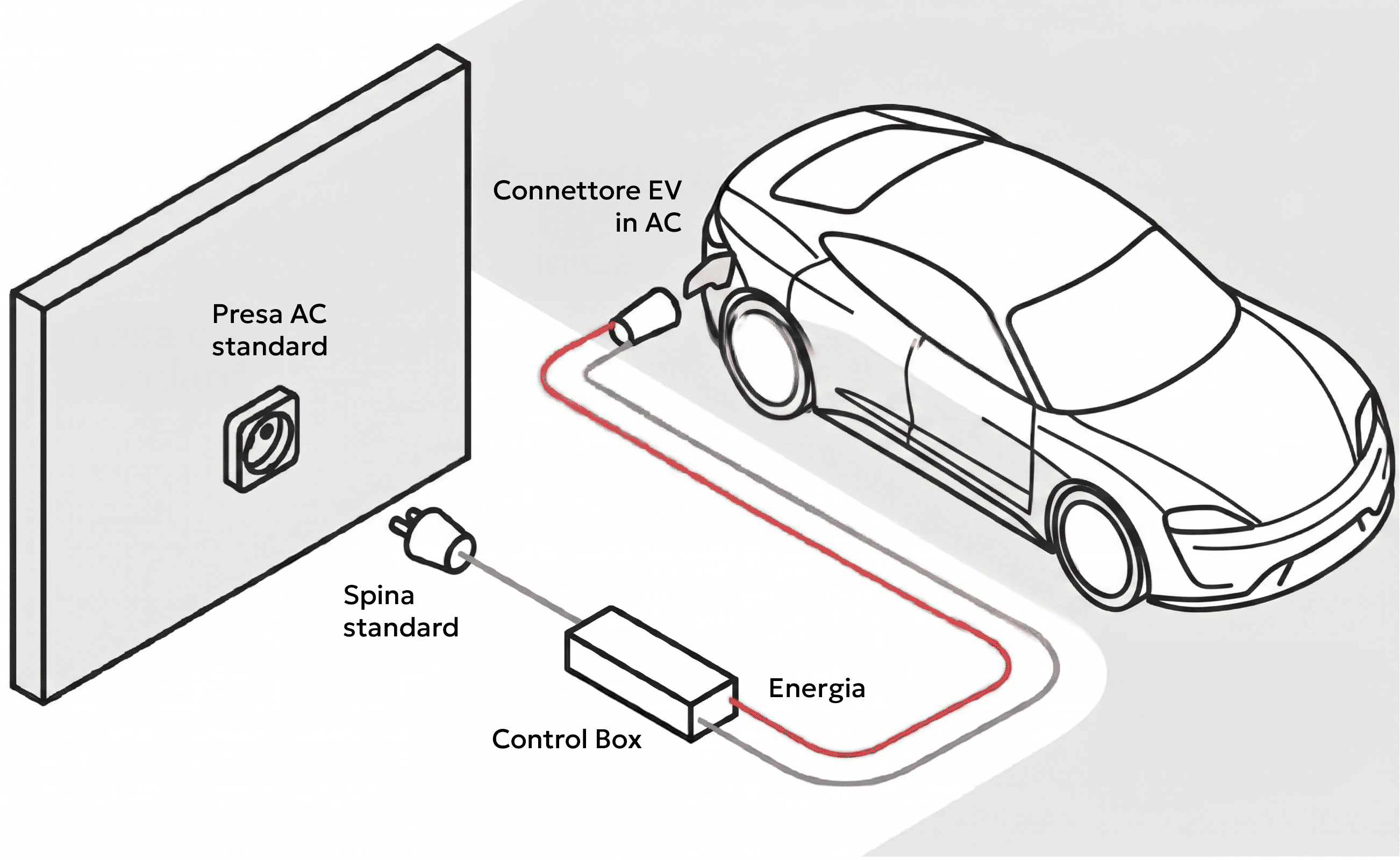
The portable device is usually supplied free of charge with the purchase of the vehicle. This cable connects directly to a normal power plug – frequently a Schuko plug – on one end, and to the type 2 socket in the car on the other. It has an intermediate module called the Control Box, a kind of box integrated along the cable that communicates with the car and provides a basic and fundamental level of safety. Although this is the most straightforward solution, requiring no installation work, using a standard home charging socket for an electric car for many hours at a time, at high power, can expose the system to serious risks of overheating, because traditional domestic wiring is not designed to cope with maximum loads for 10 or 12 hours in a row. For this reason, Mode 2 is generally considered an emergency solution, or only suitable for those who travel very short distances per day, prudently limiting absorption to no more than 8 or 10 amps, approximately 1.8 to 2.3 kW.
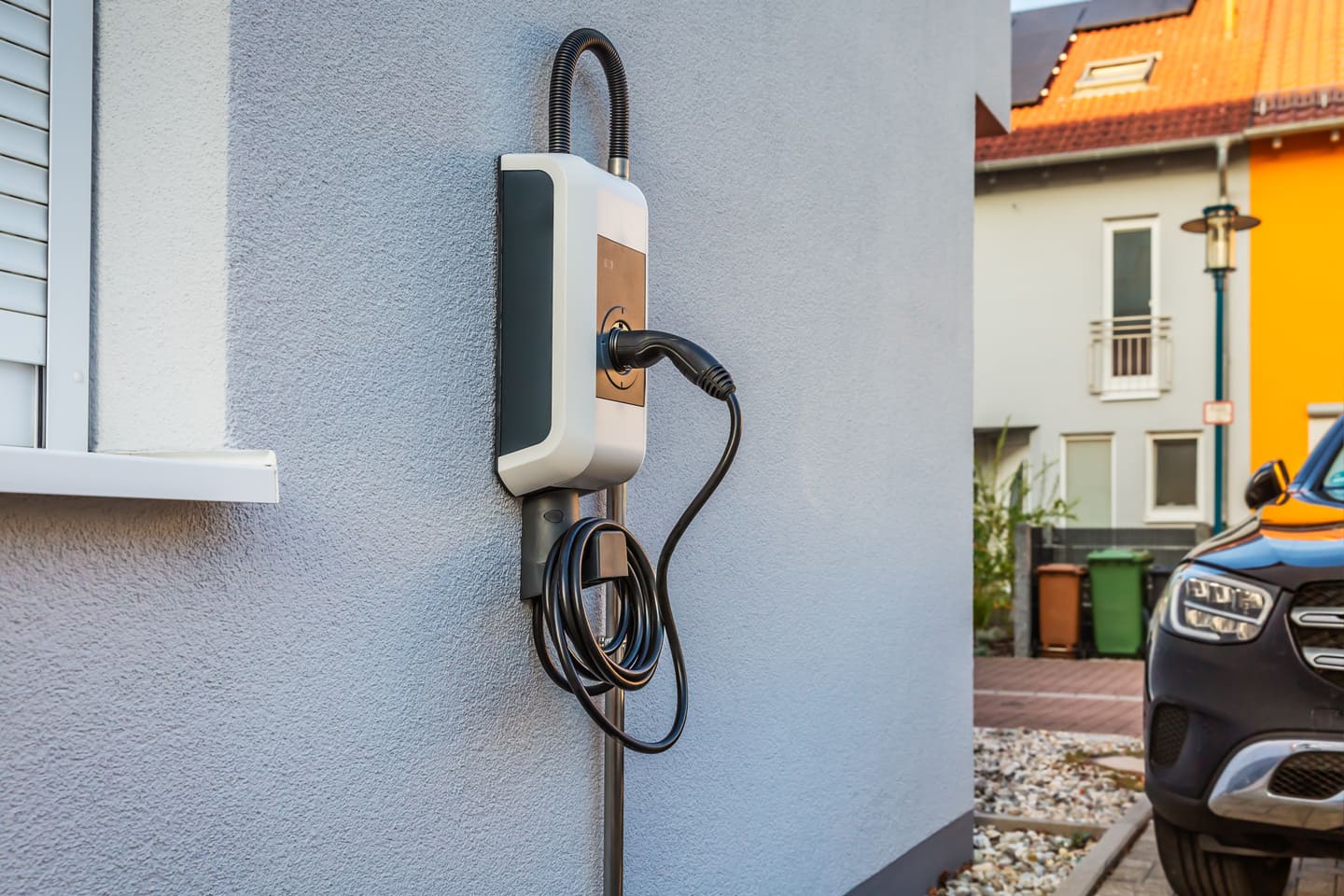
The definitive alternative – much safer, faster and more efficient – is the Wallbox. This fixed device is installed on a wall or a stand, and is specifically designed to safely cope with high current loads for many hours at a time. Wallboxes communicate constantly and in real time with the vehicle’s electronics, monitoring the integrity of the connection, the temperature of the system and instantaneously interrupting the power supply in the event of power surges or other grid anomalies.
So how do you choose the perfect device for your needs? The selection of the ideal hardware is a crucial step, and is based on three fundamental parameters:
The first is the power of the car’s on-board charger: The element that determines the alternating current (AC) charging speed is not only the Wallbox, but also the car’s internal transformer. Every vehicle has a maximum accepted power limit. For example, it is a pointless and unnecessary expense to purchase and install a three-phase 22 kW Wallbox if your car is designed to accept a maximum of 7.4 kW; in this scenario, the energy flow will always adapt to the lower limit of the vehicle.
The structure of your home’s electrical system: Almost all homes in Italy are equipped with a single-phase system with a contracted power of 3 kW. To recharge a modern car smoothly and in a reasonable amount of time, it is almost always advisable to request an increase in contracted power (to 4.5 kW or 6 kW) from your energy supplier. To deliver an output of more than 7.4 kW, it is imperative to have a three-phase system, which is rarely found in purely residential contexts, but extremely common for offices and companies.
The latest generation of Wallboxes are not mere switches; they are actual intelligent hubs. They offer Wi-Fi or Bluetooth connectivity, enabling complete remote control via dedicated smartphone apps. They enable activation times to be programmed with extreme precision (to take advantage of the night-time tariff bands when energy is cheaper), and a major advantage is that they can be directly integrated with domestic photovoltaic systems, diverting excess self-produced solar energy directly into the car battery.
Costs and times for charging electric cars at home
The biggest question asked by motorists planning to adopt home charging undoubtedly regards the impact of the car on their energy bills and the time required for a full charge. Mastering these two metrics is essential for optimising costs and planning travel routines with peace of mind.
Home charging time for an electric car is never a single, absolute figure, but the mathematical calculation required is simple: the total capacity of the vehicle battery (expressed in kWh) divided by the actual power delivered at that moment by the charger (expressed in kW). If, for example, you have a car equipped with a 50-kWh battery pack and you are using a device set to deliver 3.7 kW of net power, a full session from 0% to 100% will mathematically require around 13-14 hours of uninterrupted connection.
If the system is equipped for this, and a 7.4 kW output is available, the time required will be halved to about 7 hours: the average time your car is parked overnight in the garage. However, it is essential to emphasise that in real life, we rarely run the battery down to zero and then charge it to 100%. It’s much more common – and correct – to simply “top up“, i.e. recharge the 30, 40 or 50 kilometres consumed during the day’s commute.
Shifting the focus to operating expenses, the cost of home charging is directly dependent on the tariff you have chosen from your electricity supplier. If we consider an overall average cost (including system charges and excise duty) of night-time energy of approximately 0.25 € per kWh, you will spend 12.50 € to ‘fill up’ a 50-kWh battery pack. To explore energy tariffs and optimise consumption, it is useful to evaluate the different options available.
Preventing and solving home charging problems for electric cars
Despite the obvious and numerous benefits of the transition to electric vehicles, some inconveniences may arise during daily use, without proper technical training and professional advice. The most frequent problems with recharging electric cars at home stem almost exclusively from mismanagement and misunderstanding of the electric power available and the structural weakness of outdated domestic systems.
To avoid installation issues and to ensure maximum efficiency, it may be useful to take a closer look into the subject of electric mobility and related technologies, and to compare home charging methods with charging using the private infrastructures on main roads.
Another critical issue emerges when relying on precarious solutions. Relying on makeshift extension cords, uncoiled cable reels or plugging the portable cable into an old, poorly wired or inadequately cross-sectioned home car charging socket leads to serious voltage drops and generates a dangerous joule effect that can melt plastics or trigger short circuits. It is imperative to have the installation checked by a certified electrician. To consult official guidance and detailed information on energy security, you can refer to the Ministry of the Environment and Energy Security.
Optimising electric car charging at home
The definitive transition to electric mobility requires not only a technological upgrade, but a profound, authentic shift in logic and behaviour: unlike in the past, vehicles receive power when they are not in use, mirroring the way in which we manage the battery of our phones, charging them every night.
To sum up, charging your electric car at home is a technologically mature, structurally safe and convenient operation with easily quantifiable costs, provided that you do not try to do your own installing and that you choose hardware with the proper dimensions for your actual and specific mobility habits.
Read also
Information is energy for the mind. Explore articles, offers, and news dedicated to the world of electric mobility and stay up-to-date on everything IPlanet.

Download our App
Did you know? Keep everything under control with IPlanet. Find easily your nearest stations, start charging, monitor your consumption in real time and manage your payments. Electric mobility has never been so easy.
Find out more
Electric mobility, everywhere.
IPlanet offers you a complete ecosystem of online and offline services to simplify travel. EV charging points, traditional fuel pumps and refreshment areas: every last detail has been designed to guarantee you a complete experience. Control everything at a click on our App and website!
Find our more
Iplanet. The ultrafast solution to your charging needs

Find your nearest charging point
Use our ultrafast charging points and dedicate more time to the things you love.

Pay directly from the App
Start charging from your smartphone to save time and money
Benefits and deals
Follow our channels to discover more promotions just for you.
Our Energy
is 100% Renewable
IPlanet certifies the origin of all the energy supplied by its ultra-fast charging stations. In 2024, we received a Cancellation Statement from the Energy Services Manager (GSE), confirming the cancellation of 260 Guarantees of Origin, equivalent to 260 MWh of renewable energy used.
