
Magazine
Charging times for electric cars: how charging speed is changing mobility
When buying an electric car, one of the motorist’s first concerns is knowing how much time it will take to charge it. Daily commitments don’t leave us too much space or downtime to “wait” for our car to fill up. For this reason, especially for those taking their first steps in this world, electric car charging time remains a significant psychological hurdle and an extremely frequent question. In the early years of the commercial spread of battery-powered vehicles, what many experts called “range anxiety” was created. Today, thanks to the introduction of increasingly high-performance and high-capacity battery packs, the focus of motorists has inevitably shifted. The question is no longer just how far we can drive on a full tank of electrons, but more importantly, how quickly we can charge an electric car efficiently, whether for a long business trip or just for managing daily routines.
Compared to traditional refuelling at a petrol or diesel pump, the approach to refuelling an electric vehicle is radically different, almost reversed, and integrates flexibly and organically with our daily habits and pace of life. Knowing exactly how much time it takes to charge an electric car to ensure you have enough power is a fundamental and essential aspect of planning travel with peace of mind, whether it is the brief weekly drive between home and work, or longer, more complex motorway journeys for summer holidays with the whole family.
What does charging duration for an electric car depend on? Analysis of technical factors
First, it is very useful to clarify the specific technical factors that influence and determine the waiting time. The charge time of an electric car is not, in fact, a fixed value that applies equally to all models on the market. On the contrary, it is the dynamic result of a complex equation involving three main technical elements:
- the total capacity of the vehicle battery
- the maximum power accepted and handled by the vehicle’s on-board charger
- the actual power delivered by the external charging station, expressed in kilowatts.
A clear understanding of this technological synergy helps to understand in detail how quickly an electric car recharges depending on the exact context. For example, a car equipped with a 50 kWh battery, if plugged into a normal household socket known as a Schuko charger, which typically delivers about 2.3 kW, will take more than 20 hours to complete a full charge cycle from zero. Conversely, if the same car is connected to a very high-power infrastructure, the time is drastically reduced. In addition, the so-called “charging curve” developed by the vehicle software plays a crucial role in this operation: modern lithium-ion batteries recharge very quickly and linearly up to 80% of their total capacity, and then slow down energy absorption sharply for the remaining 20%. This safeguarding mechanism serves to preserve the chemical longevity of individual cells and prevent damaging overheating phenomena. Consequently, when wondering for the first time how much time electric car charging requires on the road, it is always advisable to think in terms of the classic “10%-80%”, the optimal range that perfectly balances time spent and energy stored.
Urban charging, smart parking and 22 kW charging column times
The daily habits of zero-emission car drivers generally fall into two main groups: slow night-time recharging in the garage at home and medium-power charging spread over various daytime activities. In this specific local mobility scenario, AC stations are undoubtedly the most widespread public infrastructures in town and city centres. When we talk about 22 kW charging column times, we are referring to what is currently the most common standard for public destination infrastructures, often strategically installed in car parks, near large office complexes, supermarkets, gyms or shopping centres.
But exactly, how quickly can you charge an electric car using these city stations? To calculate this accurately, you must first check the technological limits of your on-board charger. Although public charging stations theoretically deliver 22 kW, many cars currently on the market can only accept a maximum of 11 kW in AC, or, in slightly older cars, 7.4 kW in a single-phase configuration. If our car is equipped with a 60 kWh battery pack and an internal charger limited to 11 kW, it will take about five and a half hours for a full charge. If, on the other hand, the vehicle fully supports 22 kW three-phase absorption, as some specific models do, the wait drops dramatically to less than 3 hours. Considering these charging times for a 22 kW charging column very carefully is essential for those motorists who do not have the possibility of installing a home wallbox. These people use the time spent shopping, watching a movie at the cinema or working in the office to fill up on energy. “Opportunity charging” makes the wait irrelevant.
The technological evolution of superchargers to radically reduce electric car charging time
While recharging with alternating current is perfect for long urban stops and city life, for long motorway journeys the technical model must change radically, relying exclusively on powerful direct current. In recent years, the relentless development of Fast and Ultrafast charging technologies has completely revolutionised and significantly improved the travel experience.
Initially, the established standard for fast charging on public roads was around 50 kW of maximum power, requiring stops of about an hour to recover much of the useful range. Today, the industry has pushed far beyond expectations. Modern High Power Charging stations commonly deliver 150 kW, 300 kW and in some cases up to 400 kW. This breathtaking technological acceleration has slashed charging times for an electric car to values that are absolutely comparable with those of a classic service station stop. Thanks to state-of-the-art, liquid-cooled cables that can handle extreme amperages without overheating, next-generation vehicles are able to rack up more than 100 kilometres of valuable range in just 5 minutes.
Next-generation infrastructure: how the IPlanet network is cutting car charging time
IPlanet is a particularly virtuous example of how infrastructures are evolving to provide better support to the end user. The ambitious plan put in place by IPlanet involves the conversion of more than 500 traditional petrol stations into digital e-mobility hubs. These facilities accommodate the installation of latest-generation fast and ultra-fast charging stations, able to deliver extraordinary power of up to 400 kW, drastically reducing the electric car charging duration.
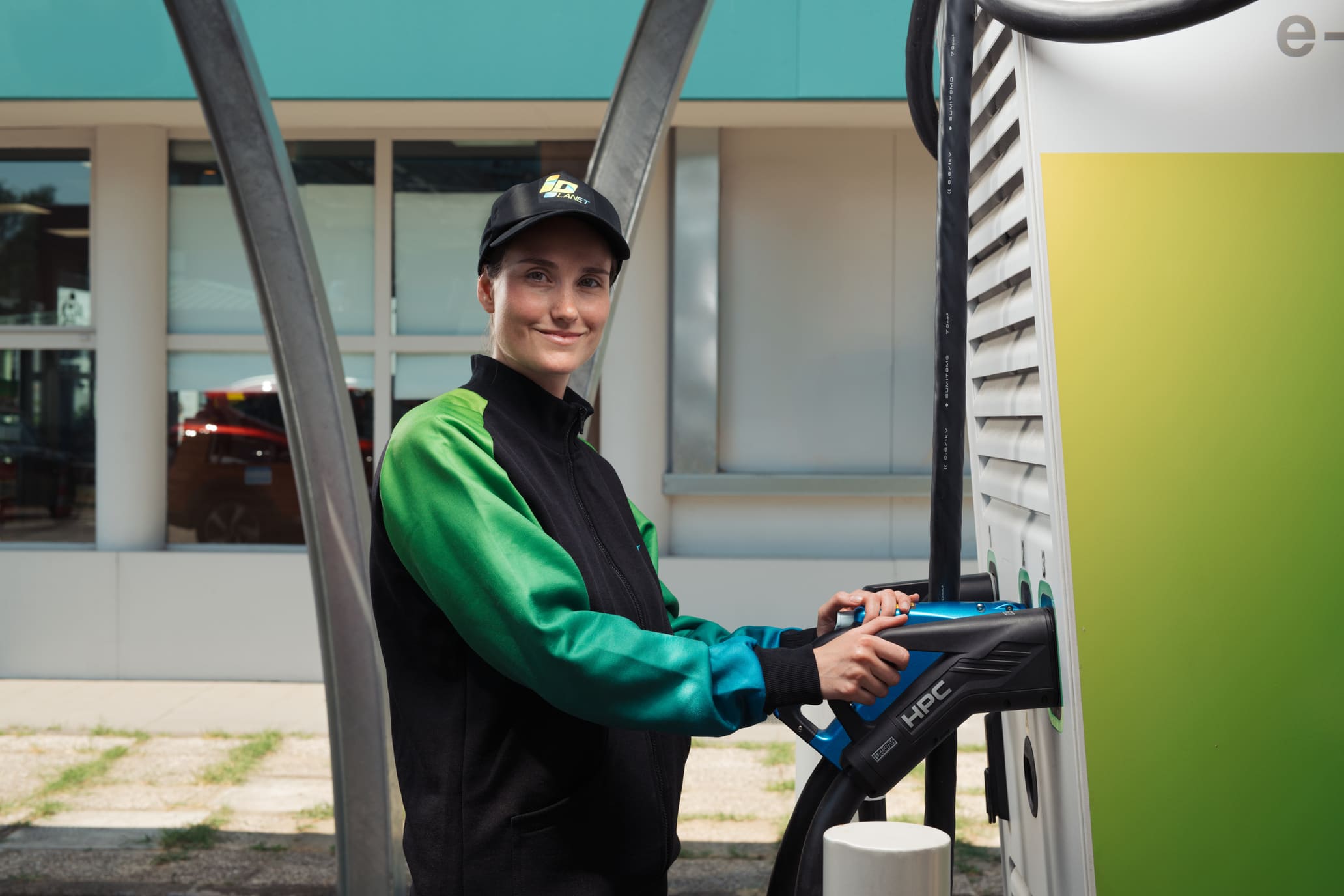
These new high-performance charging stations are strategically positioned not only along main urban arterial roads, but with a strong focus on the extra-urban network, in the heart of industrial areas and along high-density traffic hubs. For motorists still wondering how long it takes to recharge an electric car at one of these futuristic IPlanet stations, the aim is for the experience to be almost immediate. Through the official app, the user can plan the route, book the stall to avoid queues and start charging. And if you are used to the classic 22 kW charging column times in city centres, experiencing the power of the ultra-fast stalls will be a revelation. The battery can recover 80% of its charge in a span of time between 15 and 20 minutes.
But what really sets IPlanet apart is not just megawatt charging power. The focus is on the traveller. While the car is connected to the cable, the motorist is not forced to wait passively behind the wheel in an isolated spot. The IPlanet hubs are designed to offer an ecosystem rich in complementary services. Comfortable food & beverage areas for a quick meal or a nice cup of coffee, shopping areas, modern car wash facilities and practical lockers for e-commerce parcel pick-up. In this ecosystem, the charging time turns from a boring stop into a useful, relaxing break, completely redefining the refuelling experience.
A new way of travelling
Knowing how to manage the dynamics of energy storage allows you to drive with confidence in any situation. Urban AC recharging remains vital for basic infrastructure and commuting, but it is undeniable that reducing motorway waiting times is essential for the large-scale adoption of battery-powered cars. The introduction and expansion of ultra-high-power networks such as IPlanet are breaking down old psychological barriers, confirming that long-distance travel is now practical and sustainable. Interminable tailbacks along trunk roads belong to the past: setting back off quickly toward your destination is simply the new normal.
Read also
Information is energy for the mind. Explore articles, offers, and news dedicated to the world of electric mobility and stay up-to-date on everything IPlanet.

Download our App
Did you know? Keep everything under control with IPlanet. Find easily your nearest stations, start charging, monitor your consumption in real time and manage your payments. Electric mobility has never been so easy.
Find out more
Electric mobility, everywhere.
IPlanet offers you a complete ecosystem of online and offline services to simplify travel. EV charging points, traditional fuel pumps and refreshment areas: every last detail has been designed to guarantee you a complete experience. Control everything at a click on our App and website!
Find our more
Iplanet. The ultrafast solution to your charging needs

Find your nearest charging point
Use our ultrafast charging points and dedicate more time to the things you love.

Pay directly from the App
Start charging from your smartphone to save time and money
Benefits and deals
Follow our channels to discover more promotions just for you.
Our Energy
is 100% Renewable
IPlanet certifies the origin of all the energy supplied by its ultra-fast charging stations. In 2024, we received a Cancellation Statement from the Energy Services Manager (GSE), confirming the cancellation of 260 Guarantees of Origin, equivalent to 260 MWh of renewable energy used.
