
Magazine
Sustainable cities and communities. The future of urban areas
Over the past 10 years, the world has been experiencing an unprecedented urban transformation. Today, more than 70% of the European population lives in densely populated urban areas, making the shift towards sustainable cities and communities crucial.
Once mere settlements, subsequently expanded due to population growth and later designed to foster economic growth, urban areas are now redefining their identity, embracing the concept of sustainability.
The evolution of cities and communities towards a sustainable model
While some areas are still at a very early stage in this transformation, in others the process is being shaped through spaces where social innovation is compatible with quality of life and respect for the environment. Burgeoning urbanisation leaves no room for moving backwards, and requires new forms of urban planning, with policies that promote low emissions, energy efficiency, the circular economy, social inclusion and regeneration of spaces.
Urban policies, the soul of eco-sustainable cities
Modern urban planning policies cannot ignore environmental sustainability. In compliance with EU climate targets, local authorities in Europe are implementing programmes with low-emission mobility strategies and low-energy buildings.
The European Commission has promoted important instruments such as the Urban Greening Framework, geared towards transforming the urban fabric into a network of connected green areas, public spaces and natural corridors. This approach makes a sustainable city not only greener, but also more resilient in the face of climate change, water scarcity and pollution. There’s more to the Urban Greening Framework than the creation of parks or green areas. It seeks to construct an entire network comprising urban forests, tree-lined avenues, and specific buildings with green roofs and vertical forests. These projects are designed to integrate with residential and industrial urban development. Of crucial importance in this respect is the use of natural elements such as trees and plants to provide ecosystem services such as air purification, rainfall drainage and heat control.
From smart cities to regenerative communities
Technologies play a key role in the development of eco-sustainable cities, and span various fields. In this sense, not only design, but indeed actual buildings, are of significant importance, as are mobility solutions. Data are particularly crucial to this transformation. They have a very useful role to play, not only in analysing the current situation, but also for making forecasts and thus identifying possible interventions or strategic improvements to be implemented.

Within this framework, Europe’s sustainable cities are making great strides ahead thanks to the adoption of technologies such as the digital management of water networks or the use of shared mobility applications. These interventions not only boost urban efficiency, but also encourage the active participation of the community in making the city a better place to live.
Concrete examples of urban transformation
As mentioned, urban transformation is a matter not only of politics, but also of community initiatives and shared actions that can take small steps towards big changes. Community allotments and all the other forms of urban agriculture are examples of a move in this direction, as are the resulting small farmers’ markets and renewable energy communities. Actions are important, but no less so is awareness-raising through environmental education programmes in schools, and also aimed at adults, with meetings, conferences or courses that are helping to turn neighbourhoods and city centres into tangible examples of sustainability.
A recent analysis of European urban policies shows how cities have created networks to exchange best practices, funds for green projects, incentives for environmentally friendly renovations and mechanisms for civic participation. All this helps to spread the culture of sustainability even in smaller or outlying areas, where it is more difficult to set this type of virtuous processes in motion.
Challenges facing local governments seeking to create green and resilient environments
Despite the progress made, local governments continue to face many challenges in creating cities with a sustainable future. The urban transition requires significant investment, technical training and cultural change that is often slow.
Limited resources
Many European cities are facing the problem of limited financial resources. Planning new green infrastructure and developing efficient public transport systems requires funds that are not always available in local council budgets.
The creation of eco-sustainable cities requires a comprehensive rethink of the way people move, work and consume in the city, so local governments must endeavour to strike a balance between the needs of mobility, economic development and environmental protection. This can generate conflict: for example, limiting car traffic in city centres improves air quality, but may require investment in transport alternatives and create discontent among part of the population.
Climate adaptation and urban resilience
Sustainable cities and communities must also be resilient. Adaptation to climate change, including heatwaves, floods and droughts, requires carefully structured contingency plans and infrastructure able to cope with extreme events. This is why many administrations are investing in solutions such as green roofs, sustainable drainage systems and ecological corridors to increase urban resilience.
Social inclusion and community participation
Another challenge regards social inclusion: a sustainable city must be a fair place for all, leaving no vulnerable groups behind. This requires participatory processes, access to decisions and tools to ensure that the benefits of sustainability are evenly distributed. This is the only way for European sustainable cities to become environments conducive to collective well-being and not exclusive spaces for the few.
Electric mobility and charging infrastructure, a pillar of sustainable cities
In the context described, electric mobility is one of the key elements in the development of sustainable communities and the transition towards a sustainable city of the future. The progressive spread of electric vehicles, both private and shared, contributes significantly to reducing CO₂ emissions, air pollution and noise, and improves the quality of urban life. To make this change really effective, however, it is essential to invest in a widespread network of charging stations that are accessible and integrated into the urban fabric.
The most advanced eco-sustainable cities are planning and implementing smart charging infrastructures, powered by renewable energy and strategically located in public car parks, service stations, shopping centres and interchanges. This approach is conducive to more equitable and inclusive mobility, making the city sustainable and usable even for those who do not have private spaces for home charging.
In the European sustainable city model, electric mobility is often accompanied by incentive policies, such as tax breaks, free access to LTZs and integration with public transport. These interventions make electric mobility not only an environmentally friendly choice, but also an affordable one, helping to create examples of sustainable cities able to combine innovation, respect for the environment and collective well-being.

Opportunities for growth through innovation and community participation
Despite the difficulties, the transition towards sustainable cities and communities opens up enormous opportunities for innovation and social development. The development of green technologies and sustainable services generates new job opportunities and economic dynamics. Areas such as energy efficiency, water cycle management, sustainable mobility and urban regeneration offer growth opportunities for businesses and start-ups. These opportunities not only strengthen the local economy, but also attract talent and investment. Cities can use smart data and technologies to improve public services, boost energy efficiency and optimise resources. Solutions such as smart waste collection systems, adaptive street lighting and real-time environmental monitoring help local governments turn sustainable cities into efficient, modern ecosystems.
Together with the right policies, a virtuous helping hand from responsible, aware citizens really can create the perfect environment for the cities of the future.
Read also
Information is energy for the mind. Explore articles, offers, and news dedicated to the world of electric mobility and stay up-to-date on everything IPlanet.
Download our App
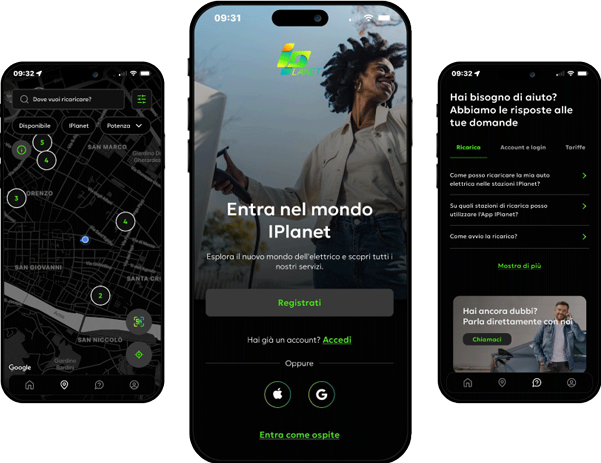
Did you know? Keep everything under control with IPlanet. Find easily your nearest stations, start charging, monitor your consumption in real time and manage your payments. Electric mobility has never been so easy.
Find out more
Electric mobility, everywhere.
IPlanet offers you a complete ecosystem of online and offline services to simplify travel. EV charging points, traditional fuel pumps and refreshment areas: every last detail has been designed to guarantee you a complete experience. Control everything at a click on our App and website!
Find our more
Iplanet. The ultrafast solution to your charging needs

Find your nearest charging point
Use our ultrafast charging points and dedicate more time to the things you love.

Pay directly from the App
Start charging from your smartphone to save time and money

Benefits and deals
Follow our channels to discover more promotions just for you.
Our Energy
is 100% Renewable
IPlanet certifies the origin of all the energy supplied by its ultra-fast charging stations. In 2024, we received a Cancellation Statement from the Energy Services Manager (GSE), confirming the cancellation of 260 Guarantees of Origin, equivalent to 260 MWh of renewable energy used.
